

Choosing a DVB-T antenna
Choosing a terrestrial antenna
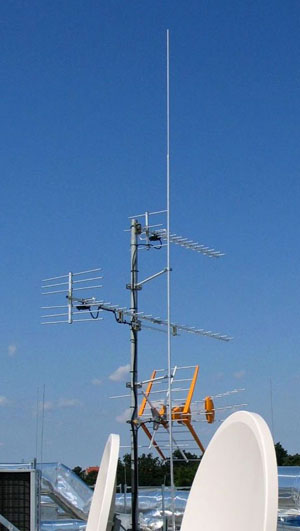
Choosing an antenna is not simple. The antenna installation should be matched to the local reception conditions. Several factors should be taken into account.
When planning the purchase of an antenna, the following should be determined:
- • the location and directivity of the TV transmitters relative to the reception site
- • the transmitter power
- • the channels on which the multiplexes are broadcast
- • the terrain configuration between the transmitter and the antenna
- • the built environment (city, open country) and woodland
- • the height at which the antenna is planned to be mounted
DVB-T transmitter powers
Range of a DVB-T antenna
Transmitter power makes it easier to determine the reception range
The greater it is, the greater the range. The terrain configuration around the house must also be taken into account – the more undulating, mountainous and wooded it is, the greater the signal attenuation will be. It is optimal when there are no obstacles on the signal path, that is, when the transmitting and receiving antennas “can see each other”. The higher the antenna is placed, the better the reception conditions will be, which is why the roofs of houses are best. Under ordinary conditions, reception of the signal from a relatively low urban transmitter tower, without additional obstacles close to the reception site, requires an antenna of the highest practicable gain – 15 dBi and more should be sufficient. Attenuation in a long cable sometimes has to be balanced by a suitable preamplifier. The main factors limiting the range, however, are precisely the height of the transmitter and the curvature of the Earth. About 30 km is therefore the limiting distance. Beyond that, reception is already very difficult regardless of the power and the gain of the antennas. If, on the other hand, the transmitter is a tall RTCN tower (radio and television transmitting centre), for example a 200-metre tower, and there are no obstacles on the path, even a small Yagi-Uda antenna with a gain of a few decibels, or a grid antenna without an amplifier, may be sufficient.
Most of the information needed will be found on the website DVBTmap.eu, which has many tools for determining the reception conditions. It contains maps of:
- • transmitters in the voivodeship and in localities
- • the multiplex coverage of a selected transmitter
- • the nearest transmitters, taking into account the distance from the transmitter, its ERP (Effective Radiated Power) and the multiplex channel numbers in the selected area.
Additional information on transmitters and multiplexes can be found from a series of lists:
- • transmitters and channels broadcasting a given multiplex in a given locality
- • multiplexes, taking into account their programme content
- • transmitters broadcasting on a given channel, taking into account the ERP power value of the given transmitter;
- • channels and the frequency corresponding to them.
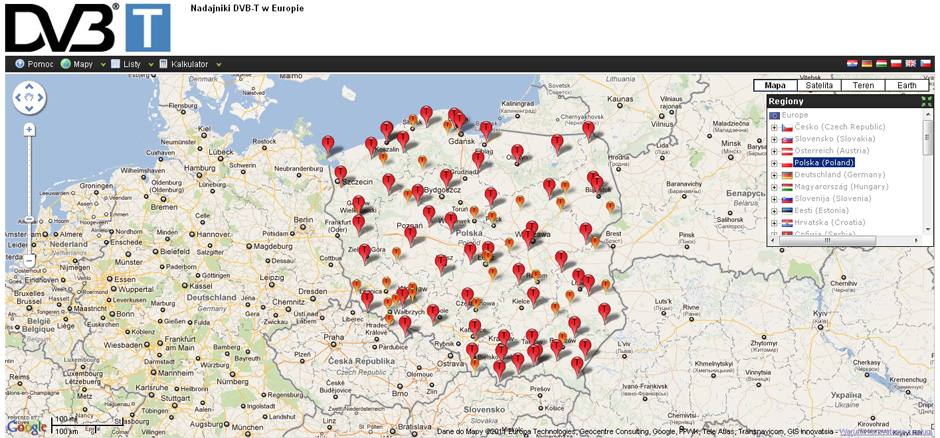
The general transmitter map shows the transmitters in the selected voivodeship or region. After clicking a transmitter icon, a window appears with basic information about the transmitter, such as the geographical coordinates and the mast height. In practice the map of the nearest transmitters is also helpful. The first step to be carried out is to establish the location of one’s own antenna on the map. Once the position is set, the map automatically displays the transmitters that meet the selected distance condition, which can be changed if there is no transmitter in the marked area. The area is shown as a blue circle.
The channel number and the transmitter power that are to be displayed can also be specified. Knowing the parameters of the transmitters at the shortest distance from our location, their coverage map can be checked. The coverage map shows the theoretical signal level for the selected channel from a specified transmitter. The area of very long-range reception is shown in green, and its boundary in yellow. It can also be checked whether the transmitter has a directional or an omnidirectional radiation pattern. If the green colour covers our location, there is a high probability that the antenna will receive the signal from the transmitter. After the nearest transmitters have been identified, the terrain relief should be checked, as it may be the cause of problems in signal reception. The map distance tool makes it possible to determine the terrain configuration between the transmitter and the reception site. By selecting the appropriate transmitter from the list and marking the reception site on the map, the distance and the terrain profile between the given points are determined. The calculation takes into account the mounting height of the antenna on the transmitting mast. The selected places are joined by a blue line. Each of the points contains the following information: the distance, the azimuth to the next point and a link that makes it possible to generate the terrain profile. Knowing the exact distance from the transmitter and using the table, a preliminary choice of antenna type can be made.
Caution! In places screened by forest, tall buildings or high-voltage lines, antennas are chosen with a gain considerably higher than would follow from an assessment of distance and terrain. The TV signal level guaranteed according to the standards is at a height of 10 m, so antennas are best mounted on the roofs of houses.
Antennas that have as few additional circuits as possible should be chosen. The optimum set is an antenna and a balun. If possible, amplifiers should be avoided, because they also amplify noise. Most problems with reception of the television signal will disappear at the moment the analogue transmitters are switched off, because the final DVB-T transmitters will be able to operate at full power. Antennas should not have an amplifier, because an amplifier matched to the analogue signal can overload a strong signal from the DVB-T transmitters, which will make picture reception more difficult.
Reflections of antenna signals from buildings
Reflections from buildings can strengthen the antenna signal
The digital DVB-T television signal is more resistant to disturbances and interference, there are no multiple images (so-called ghosts), which arise as a result of reflection of signals from buildings, which was a feature of the analogue television signal, and the picture quality of the TV programmes from the same multiplex is comparable. Good news for owners of antennas in the city is the fact that a television signal with digital modulation (DVB-T) can be strengthened as a result of reflection from buildings.
It follows from the properties of digitally modulated television waves (OFDM modulation) that signals reflected from a building can add to the main signal, improving reception, and so in situations where there is no possibility of receiving the direct signal, a signal reflected from the wall of a building can be equally good, or even better. This also applies to terrain obstacles. The mounting height of the antenna is very important. The higher the antenna is, the better. Any terrain obstacles located between the transmitting site and the receiving antenna that obstruct the view affect reception quality. In extreme cases, when the direction is completely blocked, for example by a large building, one can try pointing the antenna in another direction and try to receive a signal reflected from some terrain obstacle.
This can give satisfactory reception – it should be remembered that in digital DVB-T television the reflected signals add together, improving reception. It should be borne in mind that analogue receivers and digital DVB-T receivers react differently to critical reception conditions. If the signal is at the limit of coverage, the picture from the analogue signal will be very noisy, and the colour may disappear. With reception of the digital signal the so-called cliff effect (edge) occurs – the picture is of good quality or there is none, and when there is interference it becomes pixelated. The threshold at which the picture fails depends not only on the antenna but also on the tuner of the television receiver.
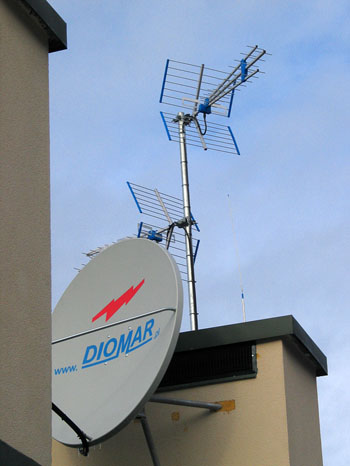
Choosing an antenna is not an easy matter when a picture of good quality is needed from different transmitters, from different bands, in cities and in the mountains. In critical situations arrays of antennas have to be used, but that is already a task for television service companies. If one decides to buy a television set for 3-4 thousand zlotys, it is worth investing several hundred zlotys in a good DVB-T antenna in order to obtain a satisfactory picture and sound.
Caution! A seller can advise the customer on the type of antenna that should be used only with a greater or lesser degree of probability. The actual installation will show whether the choice of antenna was correct and the intended result was achieved.
Installing a DVB-T antenna
Practical advice on installing DVB-T antennas
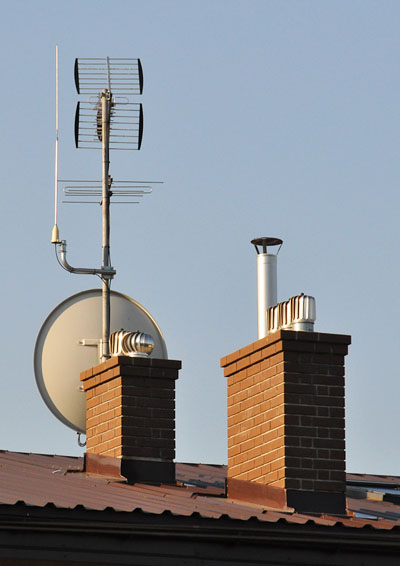
Practical advice on installing a terrestrial antenna
Directional and grid antennas because of their dimensions are supplied in parts and require assembly, and so they are intended for people with technical ability and a basic knowledge of television signal reception. Drawings make it possible to assemble them. Precise assembly of the antenna determines whether it will receive the television signal correctly. Also important are the correct connection of the antenna balun to the coaxial cable and the fitting of the antenna connector. Play between the connector and the coaxial cable can cause breaks in signal reception or the cable to slip out of the connector. It can happen that a thin copper wire of the braid shorts to the inner conductor during assembly, which makes reception of the television signal impossible. Indoor antennas are the easiest to install.
Rod and panel antennas have a compact construction. Only in the case of a rod antenna is it screwed to a base containing a balun and an amplifier. A rod antenna does not require alignment, because of its omnidirectional pattern. A panel antenna can be tried in different positions so that the signal is as strong as possible.
Checking the antenna installation
Check your antenna installation
When buying a DVB-T receiver or a new television set, it is worth checking whether the domestic antenna installation is in working order. This can be done with the aid of page no. 791 of the teletext of channel TVP2 or TVP1, which displays a test page. If all the graphic symbols are displayed on it, the antenna is aligned correctly. In some models of television sets and DVB-T receivers, the installation menu offers a signal-level indicator that can be used for this purpose and will make the optimum alignment of the antenna easier. If the antenna is on a balcony, it can be aligned by oneself. To align it on the roof it is better to call an installer who has a signal-level meter.