

Receiving satellite dishes
Reception of the television signal from a satellite.
A satellite dish serves to receive the television signal from a satellite. The picture and sound quality of the satellite decoder depends mainly on its parameters and on the LNB.
To receive the signal transmitted from the satellite, antennas are used that concentrate, at a single point called the focus, the waves incident on their surface. At the focus an LNB is placed, which converts the waves into an electrical signal sent to the satellite receiver.
Construction of a satellite dish
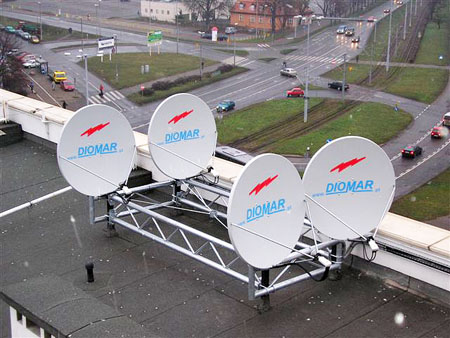
SEE THE ANTENNA INSTALLATIONS OF DIOMAR
The antenna consists of a reflector dish, called a dish or a reflector, a mount, and an arm fixed to the reflector dish on which the LNB is placed.
The reflector dish of the antenna has a shape produced by rotating a parabola about its axis of symmetry, which is why such antennas are called parabolic.
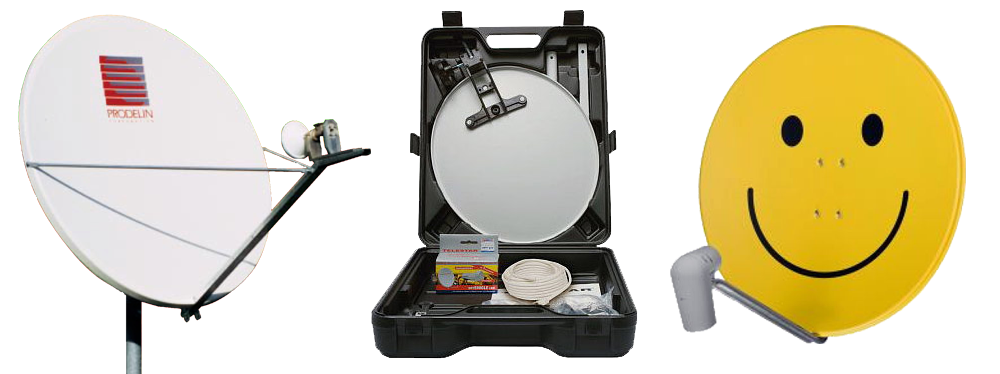
Two kinds of antenna are used: prime-focus parabolic and offset
A prime-focus parabolic antenna has its focus lying at the centre of the axis passing through the geometric centre of the antenna.
An offset antenna, also called an under-illuminated antenna, reproduces another portion of the surface, which does not contain the vertex of the parabola. The focus of the antenna is shifted relative to the antenna axis by a value called the offset.
Prime-focus parabolic antennas are easy to manufacture and make it possible to obtain an exact position of the focus, which increases the antenna gain (a larger signal), but they have their disadvantages.
Types and construction of satellite dishes
An LNB placed at the focus of the antenna obscures part of the stream of waves incident on the antenna surface, reducing the gain, particularly in the case of small antennas. The larger the antenna, the smaller the effect of this phenomenon on its gain. A disadvantage of the prime-focus parabolic antenna is its angle of inclination relative to the satellite. Rain or snow retained on the antenna surface causes the waves to reflect less well from its surface and not to concentrate exactly at the focus, which can lead to a complete loss of the signal.
In professional antennas, heating systems are fitted that counteract their icing. Large prime-focus parabolic antennas are used by television and cable stations, whereas in amateur applications offset antennas are mainly used. The reflector dishes of prime-focus parabolic antennas are round, and those of offset antennas are oval.
Reflector dishes of satellite antennas
Reflector dishes of satellite antennas are made of steel, aluminium or plastic.
Steel antennas
Steel antennas are heavy and susceptible to corrosion. Their durability and their mechanical resistance to deformation during transport or assembly are determined by the sheet thickness and the quality of the corrosion protection coating. One of the better protections is powder coating, which consists in applying paint in powder form to metal parts and then curing the surface.
Aluminium antennas
Aluminium antennas are light and resistant to corrosion. Care should be taken not to deform them during transport or assembly. Because of their low weight they are often used with rotators for changing their position.
In professional applications or in places where large antennas (100-150 cm) must be used because of a weak signal, epoxy antennas made of metallised laminate are used. They are considerably lighter than metal ones and resistant to corrosion and to mechanical deformation – even if the wind “blows them off”, they do not suffer permanent deformation.
The gain of the antenna is determined by its dimensions and the accuracy of manufacture. In an offset antenna the LNB does not obscure the antenna, thanks to which its gain is higher. The manufacturing process is more difficult, however, and the antennas do not have a point focus, but one of larger area. Offset antennas are mounted almost vertically, so they do not stand out from the wall, and neither water nor snow collects on them.
Planar antennas
Planar antennas are used mainly in motoring tourism and are mounted on the roofs of caravans or of cars (so-called campers). They work differently from parabolic antennas. On the surface of the antenna there are many small antennas that can convert the waves from the satellite into an electrical signal. The electrical signal from the individual antennas is summed and passed to the LNB (integrated with the antenna), where it is converted into signals usable by the satellite receiver.
The advantage of a planar antenna is its small size, and the durable, flat surface means that, lying on the roof of a caravan or a camper, the antenna offers little resistance while driving. The position can be controlled automatically in a simple way by means of an electric controller and an actuator that aims the antenna at any satellite and folds or unfolds it. There are also domestic versions; for example, the Maximum Flat-1 can successfully replace a reflector dish of 75 cm diameter. It has a built-in twin LNB, thanks to which it supplies the signal to two digital receivers or to one receiver with a hard disk and two inputs. The antenna dimensions of 535 x 288 x 89 mm and the white colour of the housing make it possible to conceal such an unusual satellite dish freely in awkward places, or where standard under-illuminated antennas may not be installed.
Toroidal antennas
For those who want to receive signals from many satellites without using a rotator, toroidal antennas can be recommended. Such an antenna consists of a main reflector dish and a subreflector, which focuses the beam reflected from the larger dish at different places depending on the angle of incidence. Depending on its size, up to 8 or 14 LNBs are mounted on it, on a special rail. The position of each LNB can be adjusted (a graduated scale helps with this) in order to obtain the maximum signal from the satellite.
Mounts of parabolic antennas
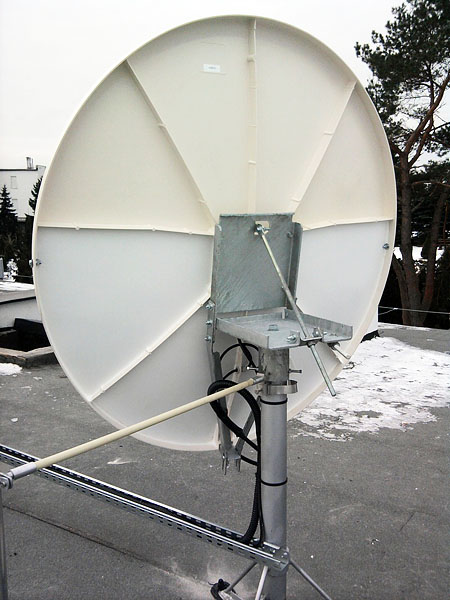
The mount of the antenna reflector dish makes it possible to adjust the angles by which its position is changed, so as to point it towards the satellite as well as possible.
Two types of mount are distinguished in parabolic antennas:
- azimuth – elevation, designated A-E or Az/El
- polar (polarmount).
An A-E mount is used on an antenna that receives the signal from a single satellite, and on it the elevation and azimuth angles are changed by hand. Easier alignment of the antenna relative to the required satellite is provided by the polarmount, invented by astronomers. The accuracy with which the antenna is aimed at the satellite is 0.01°. By using a telescopic actuator or a motor with a suitable gearbox, the position of the antenna relative to the satellites can be changed remotely with the aid of an electric positioner.
A simple A-E mount is made of metal parts or of plastic. It is usually fixed to the antenna with 4 screws and has a simple clamp for mounting the antenna on a mast. A scale on the mechanism for changing the elevation angle makes it easier to set the required angle and to lock it so that it does not change in a strong wind.
Planar antennas
Antenna arm
A boom, or an arm fixed to the antenna reflector dish with a clamp for the LNB, makes it possible to place the LNB at the focus of the antenna. The LNB clamp itself can hold one LNB, two LNBs (a so-called cross-eyed arrangement) or several LNBs (multifeed), receiving the signal from one satellite or from two (usually Astra and Hot Bird) or from four satellites located close to one another.
How large a satellite dish should one choose?
Most Polish-language programmes of pay satellite platforms, both unencrypted and encrypted, are broadcast by the satellites Astra 19 °E and Eutelsat Hot Bird 13 °E.
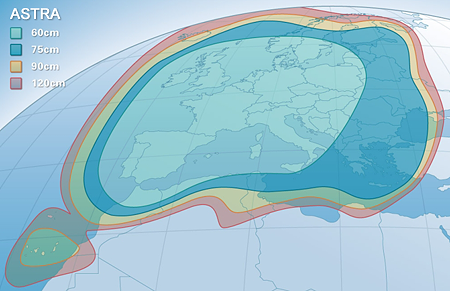
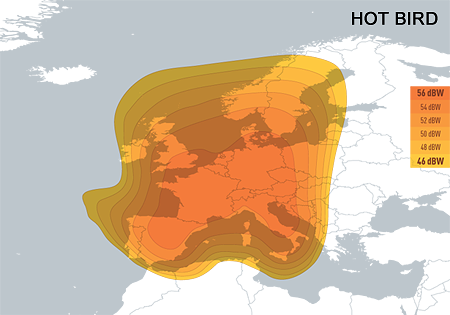
Selecting the size of a satellite dish
Selecting the antenna size depends on the region of Poland and on the kind of signal received (whether it will be SD and HD), on the number of satellites and on their coverage.
The zones of correct reception of the satellite signal depend on the antenna size from the most popular satellites – Astra and Eutelsat Hot Bird, for antennas with a diameter of up to 65 cm. From the graph for the Hot Bird satellite it can be seen that the antenna should be larger than 65 cm in order to be sure that the signal will be received in eastern Poland. In the areas of western and central Poland, when receiving the signal from two satellites, for example Hot Bird and Astra (in a cross-eyed arrangement), the optimum diameter is 75-90 cm, and in eastern Poland 90-120 cm. When receiving from a single satellite, smaller antennas are sufficient in western and central Poland (60-75 cm), and in eastern Poland 75-90 cm. Antennas smaller than 60 cm can be used, but it should be borne in mind that in difficult weather conditions (rain, snow) the picture may disappear. For reception of high-definition television, larger antennas should be used (75-90 cm). A large antenna requires a solid mounting so that it will withstand a gale and the antenna will not be deformed.
Satellite dish parameters
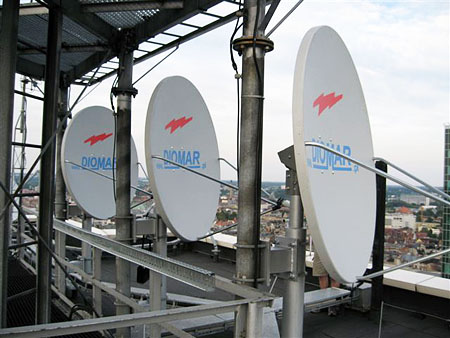
SEE THE ANTENNA INSTALLATIONS OF DIOMAR
Manufacturers of satellite dishes most often state the antenna gain, the half-power angle, the range of the adjustment angles, the mechanical strength and the antenna dimensions.
Satellite dish gain
Satellite dish gain is the ratio of the power density radiated by the antenna to the power density radiated by a reference antenna, expressed in decibels. It depends on the directivity of the antenna, that is, on the half-power angle. The smaller this angle, the higher the gain of the antenna. The second factor is its overall size. The gain increases if the antenna is larger.
Half-power angle
Half-power angle of a satellite dish is the ratio of the power density radiated by the antenna to the power density radiated by a reference antenna, expressed in decibels. It depends on the directivity of the antenna, that is, on the half-power angle. The smaller this angle, the higher the gain of the antenna. The second factor is its overall size. The gain increases if the antenna is larger.
Adjustment angle
A parameter important for installation is the range of adjustment of the angles: elevation (adjustment of the vertical position) and azimuth (horizontal adjustment of the antenna position) – the larger they are, the easier it will be to aim at the satellite.
Mechanical strength
For safety reasons, the resistance of the antenna to wind is tested, that is, at what wind force the antenna will be permanently deformed. The value of the force is stated in newtons or as a maximum wind speed.
Dimensions of a satellite dish
The antenna has an elliptical shape, and its two diameters (vertical and horizontal) are stated, together with the sheet thickness and the mast diameter.
Buying a satellite dish
When buying, attention should be paid to the surface of the antenna mirror, which should be smooth; the sheet must not be warped or have dents.
It should also be checkedwhether the antenna coating has scratches or flakes, which can accelerate corrosion. The thicker the sheet, the more resistant the antenna is to mechanical damage.
The sheet thickness is from 0.5 to 1 mm. The workmanship of the parts of the antenna mount is also important. In inexpensive antennas they are made of plastic, and in more expensive ones of galvanised steel or aluminium. The screws should be protected against corrosion.
Each manufacturer of satellite dishes offers its own range of antennas; for example, parabolic antennas are manufactured in the sizes: 0.9 1.2 1.5 1.8 m, and offset antennas 0.65 0.75 0.85 0.95 1 1.05 1.10 1.15 1.25 1.85 m.