

Satellite LNBs (Low Noise Block Converter)
What is a satellite LNB?
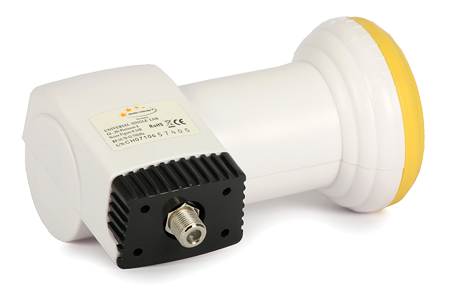
The frequency converter, called an LNB (Low Noise Block Converter), is placed at the focal point of the antenna. Its basic tasks are: converting the waves incident on the LNB feed into electrical signals, amplifying them, and shifting the signal from the range 10.7-12.75 GHz to the range 950-2150 MHz, which is processed by the satellite receiver. The frequency converter is powered from the satellite receiver with two voltages in the range 11-14 V, for a signal with vertical polarisation V (Vertical), or 16-18 V in the case of horizontal polarisation H (Horizontal).
In domestic satellite installations the following LNBs are used to receive TV channels from one satellite:
- • single,
- • twin,
- • quad.
Types of satellite LNB
Single LNB
Called single universal or fullband (for the whole Ku band), it supplies the signal to one satellite receiver.
Twin LNB
It has two outputs and supplies the same signal to two satellite receivers or to one receiver with two LNB inputs.
Quad LNB
It has four outputs and supplies the same signal to four receivers or to two receivers with two inputs.
Quattro LNB
It has four outputs, but each output has a different satellite signal and it can work only with multiswitches (satellite-signal switches). Several satellite receivers are connected to it, and they can receive different channels from the same satellite at the same time.
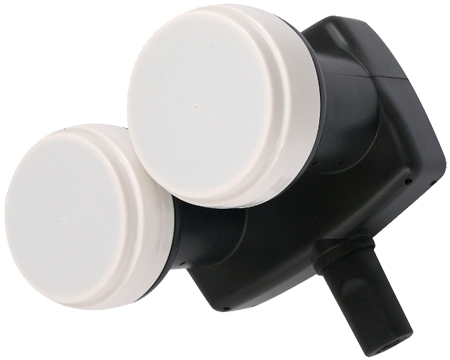
Monoblock LNBs
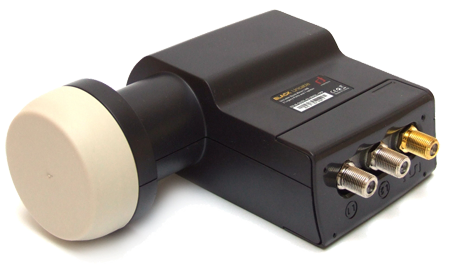
The second group consists of LNBs for reception from two satellites, of the monoblock, monoblock twin and monoblock quad types.
A monoblock LNB is two LNBs in one housing, set relative to each other so that they can receive at the same time the signals from the two most popular satellites, Astra 19°W and Hot Bird 13°E, which are 6° apart, and deliver them to the receiver.
In the monoblock twin version the LNB has two outputs and delivers them to two receivers or to one receiver with two LNB inputs, and in the monoblock quad version to four single satellite receivers or to two receivers with two inputs.
Note! Quad and quattro LNBs look the same, but they produce different signals. A quattro LNB cannot work directly with a satellite receiver; a special signal switch (multiswitch) is required. Check with the seller or in the instructions what signals the LNBs produce.
Reception of programmes from two satellites is also possible with two single LNBs mounted on the antenna in a special bracket in a so-called squint arrangement, but installing them and aligning them is more difficult than with a monoblock LNB.
Unicable LNBs
Special Unicable LNBs are gaining popularity. They contain in one housing a quattro LNB, a multiswitch and four SCR (Sat Channel Router) router circuits. At the output of each router there is a band-pass filter that separates the band intended for one tuner. Four frequencies (1210 MHz, 1420 MHz, 1680 MHz, 2040 MHz) are used to transmit the signal to 4 tuners, and each frequency is assigned to a tuner. There is also one Legacy output (950-2150 MHz) for connecting an ordinary DVB-S receiver. The satellite receiver must also have the SCR function.
Unlike an ordinary LNB, the received transponder is selected in the LNB, which is controlled from the satellite tuner.
LNB parameters
The parameter of an LNB given most often is the noise level. The smaller this value, the better the LNB.
Tip! If you do not want to buy a large antenna, invest in a good LNB with a low noise figure.
Optical LNB — a revolution in satellite technology
In the near future the traditional satellite LNB will be replaced by an optical LNB. Optical fibre technology solves a number of problems.
Optical fibre cable attenuates the signal much less than copper coaxial cable and is immune to electromagnetic interference; it can be run next to high-voltage cables or an electric motor. It is thin (3 mm thick) and easy to lay.
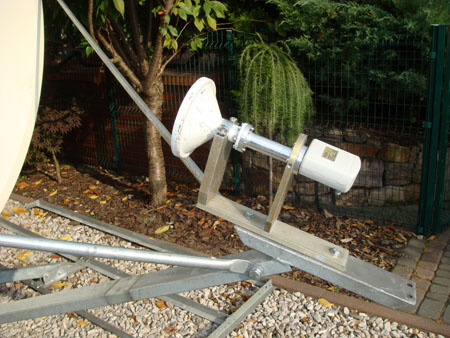
LNB stacker
The LNB itself has a built-in so-called stacker, which converts the four band/polarisation combinations into one digital signal in the range from 0.95 to 5.45 GHz, and then into an optical signal transmitted by optical fibre. Because the light stream carries the full signal band, any number of receivers working completely independently can be connected to one optical fibre, using optical splitters.
This creates an exceptionally simple system for distributing the signal to many flats. One cable, which is the source of the signal, will enter the flat and will be split into signals, for example for a DVB-S receiver with two tuners, and further receivers can be in the bedroom and in the child’s room. A classic installation would require: a quattro LNB, four cables from the LNB, a multiswitch and four cables to the receivers.