

Satellite dish brackets
Mounting satellite dishes
Satellite dish brackets are one of the most important elements, determining the stable fixing of the dish. The larger the dish, the more robust the bracket must be. They are made from steel tubes, less often from aluminium. Steel brackets are made from tubes of 32, 38 and 50 mm diameter, aluminium ones from a tube of 48 mm diameter. They may also be bent or welded at a right angle. There are many bracket designs; the most common are wall-mounted brackets, straight balcony brackets, angled brackets and brackets with a movable mounting arm. Among the stated bracket parameters are its height, the tube diameter, the distance from the wall and the dimensions of the mounting plate.
Their durability and corrosion resistance will be determined by the type and number of coating layers. The highest-quality brackets have four kinds of protective coating. The coatings may be: three painted ones (light, dark and Aluzinc) and one galvanic coating (e.g. Corab).
Galvanising of brackets
Hot-dip galvanising is an immersion method. This means that both surface preparation and coating with zinc take place by immersing the structural elements in tanks that contain baths of the appropriate chemical composition. This technology makes it possible to reach every crevice, clean it and protect it against corrosion. The final stage of the galvanising process is the application of the zinc coating to clean steel elements, which are immersed in molten zinc. The structure and the properties depend on the chemical composition of the steel substrate and also on its thickness and construction. When specified conditions concerning the grade of steel are met, in particular the silicon and phosphorus content, and when the elements intended for galvanising are suitably designed, anti-corrosion coatings are obtained that withstand mechanical damage, abrasion, erosion and impact, are free of porosity and show excellent adhesion to the substrate. In the hot-dip galvanising process, coatings with an average thickness of 70 to 150 micrometres are obtained. This thickness is sufficient to protect the steel against corrosion for many decades. The average life of the zinc coating is 30-50 years. The second process is electrogalvanising – an electromechanical process that produces a zinc layer on a conductive substrate. In an urban corrosive environment, a galvanised surface shows from several to more than ten times greater corrosion resistance than steel that has not undergone galvanising.
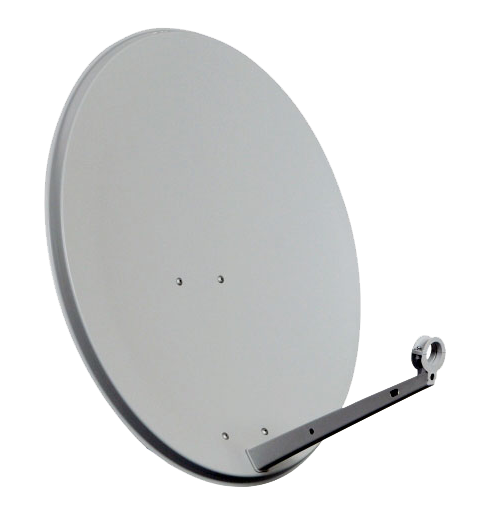
Mounting and aligning satellite dishes
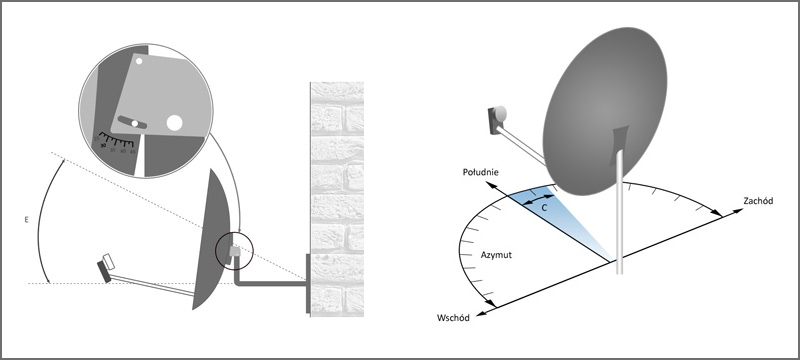
Determining the elevation and azimuth angles of a satellite dish
Advantages of satellite television
The advantage of satellite television is the possibility of reception practically anywhere in the country. Aligning a satellite dish, however, requires more knowledge than in the case of a television antenna. Three angles must be set very precisely: elevation, azimuth (which define the position of the satellite) and the LNB skew angle (minimum crosstalk between polarisations). There are certain limitations on mounting a dish in a city. It must be pointed south, and there must be no buildings or rises on the path of the signal from the satellite to the dish. The best place for mounting is the roof.
Caution! The antenna mast must be set vertically so that the stated elevation and azimuth angles make it possible to align the dish. Otherwise it will be practically impossible to aim the dish at the satellite correctly.
Aligning a satellite dish is considerably more difficult than reception of terrestrial television.
People who are not interested in satellite technology should commission a specialist company to mount and align the dish, whereas people who are interested in satellite technology will manage on their own. Below is a description of the steps that should be paid attention to when mounting the dish. The first step is to fix the dish bracket to the wall or to the balcony railing, or to place a stand in a suitable location.
Wall brackets are made of steel, aluminium or brass. Aluminium and brass do not rust; steel should be protected against corrosion and is usually galvanised. Fixing the bracket to a wall, or fixing a floor stand, requires drilling four holes and inserting plugs for the fixing screws. When fixing brackets it is important to keep the mast vertical; the elevation angle will then need no correction. It is therefore necessary to check whether the wall is vertical and the floor or railing is horizontal; otherwise corrective spacers will have to be used.
When the dish cannot be fixed to a wall or a roof, the solution is railing brackets or balcony stands. The bracket is fixed to the railing with a clamp, and the balcony stand is weighted with slabs, for example paving slabs, which ensure complete stability.
Satellite meters
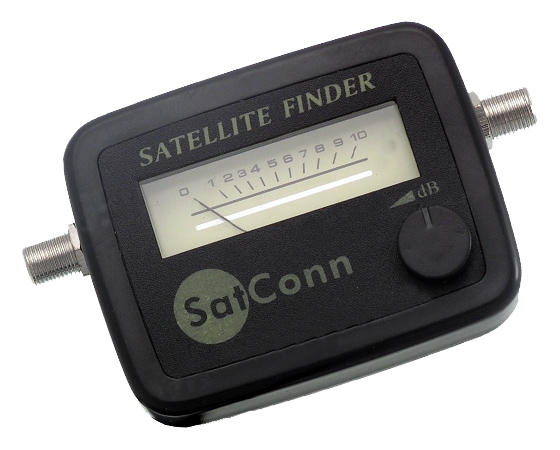
Simple or very complex meters are used to align the dish; astronomical methods can also be used.
A signal indicator is needed in order to point the dish towards the satellite. Most satellite receivers have a signal indicator showing its strength and quality. Changes in the satellite signal can be followed on the television screen when the elevation angle, the azimuth and the LNB skew are changed. An audible signal can be helpful. The higher the satellite-signal value, the more frequently the tone is repeated.
Most satellite receivers contain instructions on how to align the dish.
The instructions should include a list of the required angles for the place where the dish is located (the largest cities in Poland), or websites have to be used. A short instruction for aiming the dish at a satellite is given below.
According to the data in the instructions, the LNB skew angle should be set. The angle is measured from the vertical, anticlockwise, using the scale on the LNB. The azimuth angle is then set provisionally with the aid of a compass, and the elevation angle by using the scale on the dish mount. The strength and quality signal levels are checked with the satellite receiver’s signal-level meter displayed on the television screen. Usually the value of the so-called signal strength appears on the indicator first, which confirms that the installation and the connection to the satellite receiver are correct, but does not identify which satellite the signal is being received from. If the signal strength increases when the azimuth angle is changed, the operation is continued until the value begins to decrease. If, at maximum signal strength, the quality indicator reads zero, this means that the signal is being received from another satellite or that the elevation angle is set incorrectly. The elevation angle is changed. If a quality signal appears, the elevation angle continues to be changed until the maximum signal-quality value is reached. It may happen that the signal quality is higher than the strength. The quality-signal value is more important: it confirms that the correct satellite has been found, and the picture of the individual satellite channels should already be visible on the television screen. The final step is correction of the LNB skew angle. One of the problems in aligning the dish is the difficulty of setting the azimuth angle – measurement with a compass is not very accurate and may be disturbed by metal elements, for example a railing. The astronomical method makes it possible to determine the azimuth angle precisely.
Astronomical method of aligning a satellite dish
The astronomical method uses the position of the Sun. The dish is aligned when the azimuth of the Sun and the azimuth of the selected satellite coincide. On websites devoted to aligning satellite dishes, for a given place, for example a city, and a satellite, the exact time is stated at which the azimuth of the Sun and the azimuth of the selected satellite coincide, and the elevation angle of the Sun relative to the satellite is also stated. The measurement requires a string to be fastened to the dish and to the arm according to the drawing. On a sunny day, at the calculated hour and minute, the azimuth angle must be changed, that is, the dish must be turned in the horizontal plane, until the shadow of the string coincides with the centre of the LNB arm. This provisional setting of the azimuth angle should already cause a quality signal to appear on the signal-level indicator if the elevation angle is set correctly. Precise alignment of the dish is then continued using the satellite receiver’s signal-quality indicator (visible on the television screen or on the receiver display). The maximum signal-quality values are set by moving the dish very precisely, by single millimetres.
These steps can be carried out by one person (if the dish is on a balcony, each change of position can then be checked on the television screen), or a second person must help by watching the picture and informing the person at the dish. One person can manage the alignment by using a satellite signal meter connected between the satellite receiver and the LNB, or if the meter can power the LNB. The meter has a scale showing the signal level, and some meters provide audio monitoring of the satellite channel to which the dish has been tuned.
Ways of concealing a satellite dish
In large cities, in blocks of flats, it happens that the building administration does not allow dishes to be placed on the balcony. The dish can then be hidden from the view of the administrator or a neighbour. One of the methods is a special satellite chair that conceals the dish.
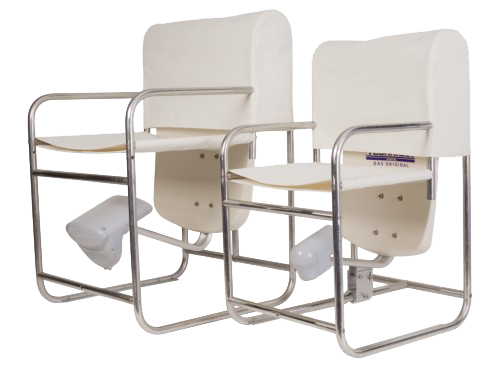
The dish is fixed to the chair, and the fabric of the backrest screens it. The density of the fabric is low enough that the waves are not attenuated and, after reflection from the dish, reach the LNB. This chair should be placed on a horizontal floor, and the required azimuth and elevation angles and the LNB skew angle must also be set in order to receive the signal from the given satellite; the dish is then covered with the fabric. Care must be taken not to knock the chair, because the whole procedure will have to be carried out from the beginning.
Another way of hiding the dish on a balcony is to mount an offset dish in an inverted position.
A special stand with height adjustment from 60 to 120 cm makes it possible to mount the dish so that the incoming waves, after reflection from it, focus on the LNB. A dish set up in this way on a balcony remains invisible from the outside.