

DVB-T antenna parameters
Properties of DVB-T antennas
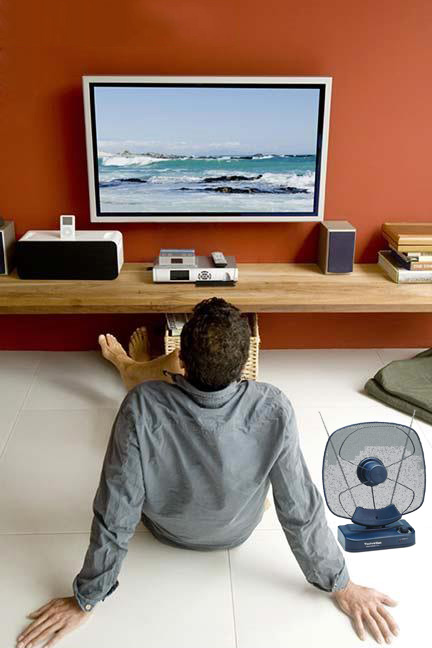
The properties of an antenna are described by parameters given on manufacturers’ websites, in data sheets or in operating instructions, and directly on the packaging. Knowing them makes it possible to make a preliminary choice of antenna for the reception site.
Let us now discuss in turn the parameters most often given by antenna manufacturers:
Band of DVB-T antennas
Band
By 31 July 2013 analogue broadcasting will have ended. Until then, in some voivodeships the analogue signal will be switched off, and in others both will coexist. One advantage of digital television is that DVB-T multiplex channels will be broadcast only in the UHF band.
At present television stations are broadcast in analogue form in channels 8 MHz wide, mainly in the UHF band on bands IV and V, and a few in the VHF band on band III. Antennas for analogue reception can receive different bands: VHF only, UHF only, or both at once (they are then called wideband). If we have a good wideband antenna, it should not be replaced with a new one. Only antennas for the VHF band will be left without a television signal, but digital DAB radio broadcasting is planned in that band.
Note! DVB-T television antennas should receive only the UHF band; they are then more resistant to interference.
Gain of DVB-T antennas
Antenna gain
One of the most important parameters is antenna gain (signal amplification), which states how many times the power of the signal from the antenna is greater than the power of a reference antenna, the so-called isotropic antenna, when they are fed with the same power. Gain is given in decibels — dB or dBi (relative to the reference antenna). Antenna gain depends on frequency, which is why the technical data include graphical characteristics of gain as a function of frequency, or of the corresponding channels, making it possible to check what signal level the received TV stations will have on specific channels.
Best gain of DVB-T antennas
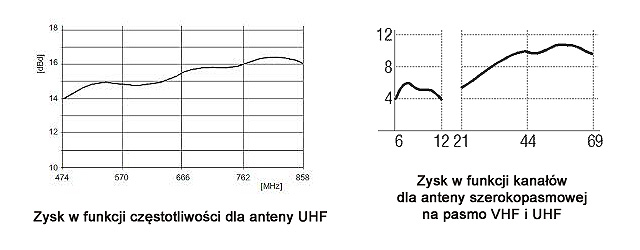
Small, simple antennas usually have a gain of the order of 3-8 dBi. They are suitable for receiving programmes at a short distance from the transmitter (10-30 km). Larger, mid-range antennas have a gain of 10-15 dBi, which allows television signals to be received at a distance of 20-60 km. The best antennas, with the largest number of elements (length about 2 m), have a gain of the order of 19 dBi, which allows reception at a distance of even 100 km and more from a high-power transmitter.
Beamwidth of DVB-T antennas
Beamwidth
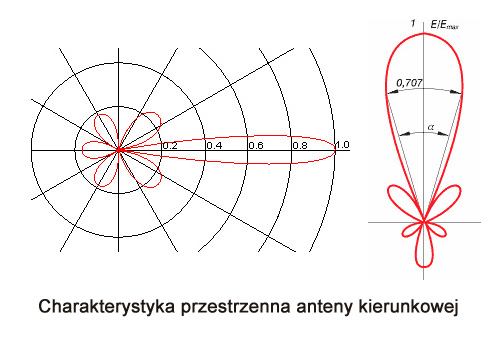
Directional properties are defined by the antenna radiation pattern, comprising the main beam and much smaller rear beams, called side lobes and back lobes.
The width of the main beam is the angle between the directions of radiation in the main beam for which the field strength falls to 0.707 (−3 dB) of its value. Because of the difficulty of drawing a three-dimensional model, two relatively perpendicular planes are usually used to describe the radiation pattern. The angle values given are those in the vertical and horizontal planes. Knowing the width of the main beam makes it possible to judge quickly whether the antenna is omnidirectional or directional.
Front-to-back radiation of DVB-T antennas
Front-to-back radiation
For professional antennas the ratio of main radiation to back radiation is given; it characterises the antenna’s ability to reject interference. The value is given in dB as the ratio of the maximum field strength of the main beam to the maximum field strength of the largest side lobe. The higher the value, the better the antenna attenuates signals from the opposite direction and interfering signals. The number of reflectors affects the value of the front-to-back ratio.
Polarisation of DVB-T antennas
Polarisation
Antenna polarisation indicates how the antenna should be oriented relative to the surface of the Earth (horizontally or vertically). This follows from the way transmitters radiate radio waves — the point is that waves from neighbouring transmitters should not be able to overlap and interfere. Both polarisations occurred in analogue television broadcasting. DVB-T transmitters broadcast the signal only in horizontal polarisation, which requires the directors and reflectors of the antenna to be set horizontally to the surface of the earth.
Electrical matching of a DVB-T antenna to the cable
Electrical matching of the antenna to the cable — impedance
Input impedance is one of the more important antenna parameters. It defines the matching of the antenna to the feeder, which is the coaxial cable. Antennas have different impedances, for example a folded dipole of 300 Ω.
Number of elements of DVB-T antennas
Number of elements
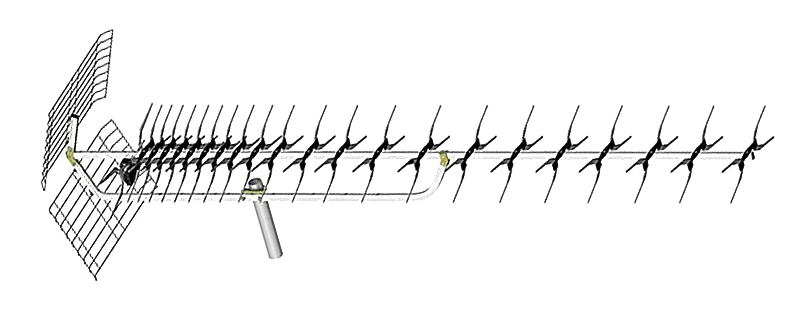
For directional multi-element antennas of the Yagi type and similar ones, for example log-periodic antennas, the number of elements is given — these are mainly directors. This number may be a dozen or so, several dozen, or even more than 100. The more of them there are, the more directional the antenna is and the higher its gain. This is the simplest way to choose the antenna with the best directivity.
Note! A significant problem is assessing the values of the parameters given by manufacturers. Manufacturers do not state the standards according to which the measurements were made. Competition means that their results are often overstated. The only way to verify how an antenna receives the television signal is a practical check.
Choosing a DVB-T antenna
Comparing DVB-T antenna parameters
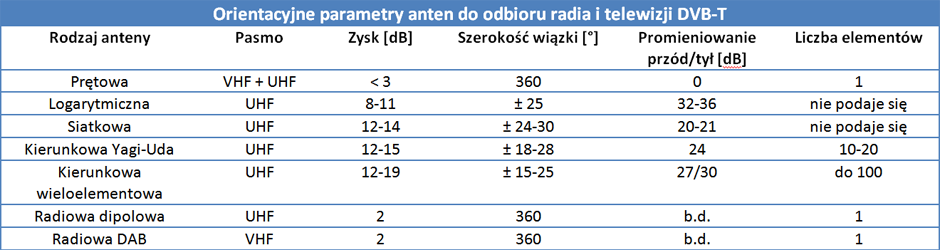
Summary of parameters according to antenna type — examples
We give indicative values for the individual types of antenna. Comparing parameters is, however, the first step in choosing an antenna. In practice, only installing the antenna will show whether the choice was correct.
Tip! Some models of indoor DVB-T antennas, mainly panel antennas, are protected against the weather and can be installed inside a room or outside the building. If reception quality indoors is unsatisfactory, installing the antenna outside will considerably improve signal quality.