DVB-T antenna accessories
Accessories for terrestrial antennas
Accessories for terrestrial DVB-T antennas
When buying a multi-element antenna, check that it has all its elements. The absence of a balun in a multi-element antenna, for example, may make TV reception impossible because of an electrical mismatch.
Balun for a DVB-T antenna
Balun
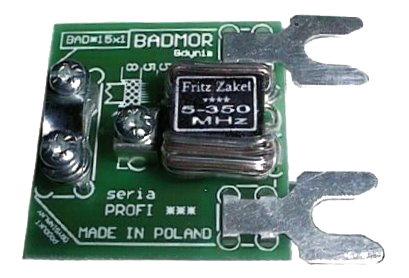
In all antennas except the log-periodic antenna a balun is required, that is an impedance transformer for electrically matching the antenna to 75 Ω coaxial cable. A typical antenna dipole has a balanced output with an impedance of 300 Ω, whereas coaxial cable is an unbalanced load with a characteristic impedance of 75 Ω. Therefore, to connect the antenna to the coaxial cable while maintaining the match, an intermediate element — a balun — must be used.
A balun is a passive device that uses a transformer to change the impedance and to pass from a balanced line to an unbalanced line. In indoor and panel antennas it is already fixed in place. Multi-element antennas should have a housing, located close to the dipole, containing the balun board. One pair of its leads is connected to the dipole; the second pair of terminals is used to attach the coaxial cable.
Amplifiers for DVB-T antennas
Is an antenna amplifier needed?
The basic rule when choosing an antenna is to avoid using antenna amplifiers, because they generate their own noise, which reduces the level of the usable signal.
An antenna amplifier will not improve the antenna signal, because regardless of its quality it cannot turn a poor signal into a good one. If at the amplifier input the ratio of usable signal to noise is low, the signal at the output cannot be better than at the antenna itself.
It is best to look for an antenna with higher gain than one with an amplifier. However, where additional amplification is necessary — in wooded and mountainous terrain and at a very great distance from the transmitter, and also with a very long antenna cable (over 20 m) with several splitters to several outlets — an amplifier must be used.
Preamplifiers for DVB-T antennas
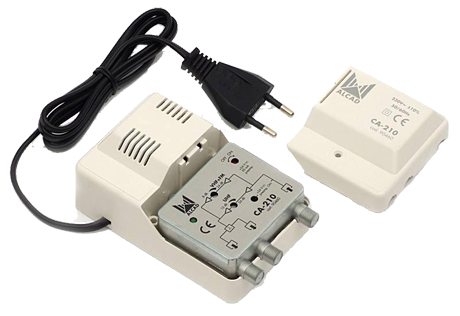
The antenna amplifier, also called a preamplifier, should be placed as close to the antenna as possible, in the housing. It usually has fixed gain, which may overdrive the signal if the antenna is close to the transmitter. It may take the form of a printed circuit board, usually rectangular, placed in a plastic enclosure; better ones have a screened metal enclosure with an F connector, or they may be mounted in a metal sleeve of a diameter only slightly larger than the coaxial cable, if the antenna has an F-connector output from the balun. If the amplifier has manual gain control, the gain can then be matched to the needs of the installation so as not to overdrive the receiver input with too strong a signal, which may cause the picture to disappear, or so as to amplify the signal in order to compensate for losses caused by the length of the coaxial cable.
Amplifiers with automatic gain for a DVB-T antenna
Amplifiers with automatic gain
A new development is antennas with automatic regulation of the output signal level. The magnitude of the output signal is important for producing a correct picture. If the level is too low, the picture may not appear, it may freeze or mosaic may appear; if it is too high, the signal will be overdriven and the picture will also be disturbed. This problem is solved by an amplifier with automatic signal-level regulation, which produces the optimum value.
Filters for DVB-T antennas
Filters
An additional problem with amplifiers is amplification of interference from mobile-telephony transmitters and of interference generated by cars.
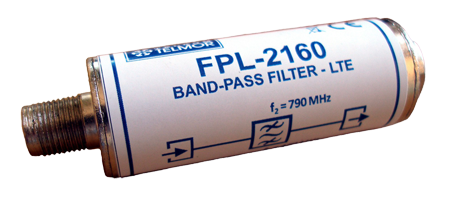
Antennas use special interference-suppression filters, e.g. CB, GSM, LTE. An example is a small amplifier in which the amplifier board is enclosed in a sleeve housing with an F-type plug and socket, convenient to install.
The amplifier has a gain of 20dB and GSM and CB filters. Comsat was the first company to bring to market filters that eliminate DVB-T signal interference coming from transmitters and devices using LTE technology, that is mobile internet transmitted in the 800 MHz band. The reception problem caused by LTE interference will appear in 2013.
Television antennas placed close to an LTE transmitter may receive its signal, which will disturb the television picture from the antenna. A tablet or laptop receiving a mobile-internet signal in the home may also be a source of interference. The problem arises from the proximity of the DVB-T television transmission bands and LTE internet. New antennas can receive channels up to and including 69, and therefore the LTE signal as well.
Interference in DVB-T antennas
That is why LTE filters should already be used today when designing or modernising a DVB-T installation. This problem can be solved in several ways. The simplest is to buy an antenna that has a built-in filter cutting off the LTE signal. Falcon antennas are recommended here, with high gain up to 790 MHZ and high attenuation in the 800 MHz band. Owners of ordinary antennas for channels 21-69 can buy an LTE filter in addition. It has an F-type connector and is fitted between the antenna and the television or DVB-T receiver (preferably at the television). There are two filters to choose from, differing in the number of outputs. In more complex installations that deliver the DVB-T television signal to several televisions, DVB-T signal amplifiers should be used, preferably with a built-in LTE filter.
Powering antenna amplifiers
Powering antenna amplifiers
Antenna amplifier supply voltage
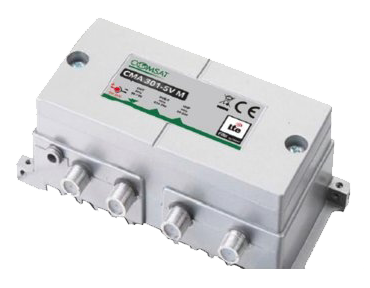
An antenna amplifier can be powered in three ways:
- • from an external power supply
- • from the antenna input of the DVB-T receiver
- • from the USB input of a computer
When buying an antenna with an amplifier, it is worth paying attention to its supply voltage. Until now this was most often 12 V from an external power supply. An advantage of amplifiers in DVB-T antennas is the 5 V supply — DVB-T receivers compliant with the digital television standard supply 5 V to the amplifier. This simplifies the installation considerably. It is enough to connect the antenna cable to the antenna input and, in the receiver menu, select the amplifier-power option, which eliminates the external power supply. Some antennas recommended for use with computer DVB-T receivers can be powered from the computer’s USB input, which also eliminates the external power supply. Older amplifiers supplied at 12 V can be powered only from an external power supply or a 12 V source, for example a car cigarette-lighter socket.
Combiners for DVB-T antennas
Antenna combiners
Antenna amplifier supply voltage
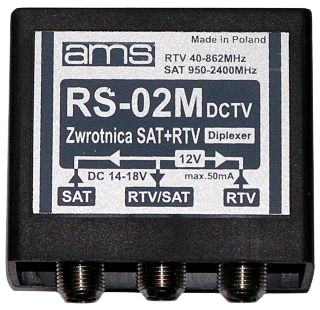
If a domestic installation is planned to deliver, over a single cable, signals from several antennas (for example a VHF radio antenna, a television antenna and a satellite dish) to several televisions or to radio, DVB-S and DVB-T receivers, a combiner will help. A combiner (for example AMS ZA-101M) with four inputs is the most universal and future-proof solution, making it possible to combine several elements of the antenna assembly.
It is used as an element that sums the signals from four antennas, mounted on the antenna mast, near the antenna assembly. Power can be sent to the antenna preamplifier through the UHF2 input. Thanks to two band-pass UHF inputs, the combiner makes it possible to sum signals from two DVB-T television transmitters. The VHF input may in future be used for reception of DAB digital radio, while the FM input allows an analogue radio antenna to be connected. The housing design prevents rain from entering the combiner. Mounting on the mast is simple thanks to a plastic strap. Rubber covers that protect the connectors from water are included with the set. Another type of combiner, for example the Technisat combiner, makes it possible to sum the terrestrial-antenna and satellite-antenna signals in one cable. To obtain a given satellite signal or a terrestrial DVB-T signal, subscriber outlets are used; they have outputs with filters that pass the given frequency band.