

Estate cable networks often receive enquiries from subscribers about additional Premium programme packages. Many cable operators, including those operating within housing cooperatives or associations, can, at very low cost, use the technology of the nc+ platform to introduce the CANAL+ package into their installations.
For many years cable operators used analogue scramblers for CANAL+ programmes in their headends and supplied their subscribers with decoders with a key. This technology was withdrawn from service a few years ago, and digital technology based on DVB-T and DVB-C transmission was made available in its place. Drawing on the economical COMPACT headend manufactured by WISI Communications, the company DIOMAR developed a method of distributing CANAL+ programmes in digital technology. Implementing the CANAL+ programme package does not require the cable operator to take any special action, either on the technical side or on the sales side. The company DIOMAR, as distributor of the CANAL+ package for local cable networks, provides assistance during implementation and throughout the period of operation of the CANAL+ package in the cable network. Our aim is to give the operator the best possible technical and sales support, because in this way we make flexible development of this offer in the operator’s cable network possible. Three programme packages are available for subscribers: the Silver package, comprising the programmes Canal+ Family and Canal+ Family 2, the Gold package with the additional programmes Canal+ Film and Canal+ Film 2, and the Platinum package, which also includes the programmes Canal+ and Canal+ Sport. The differentiated programme offer makes it possible to offer subscribers 3 Premium packages at different prices, and the cable operator can shape its own sales policy for these programme packages in a flexible way.
The technical solution already implemented in many cable networks consists in transmodulating CANAL+ programmes from the satellite signal to DVB-C or DVB-T, while retaining the encryption used in the satellite transmission. To convert the CANAL+ SD programmes, one working panel OH 85H (DVB-C) or OH 88H (DVB-T) for the COMPACT headend is sufficient. At the same time, the same panel makes it possible to decode several programmes from a thematic package — for example MiniMini+ and PLANETE+ from transponder 10.719 MHz, and AleKino + and TeleToon+ from transponder 10.892 MHz. An example set of programmes in both digital multiplexes is shown in the figure:
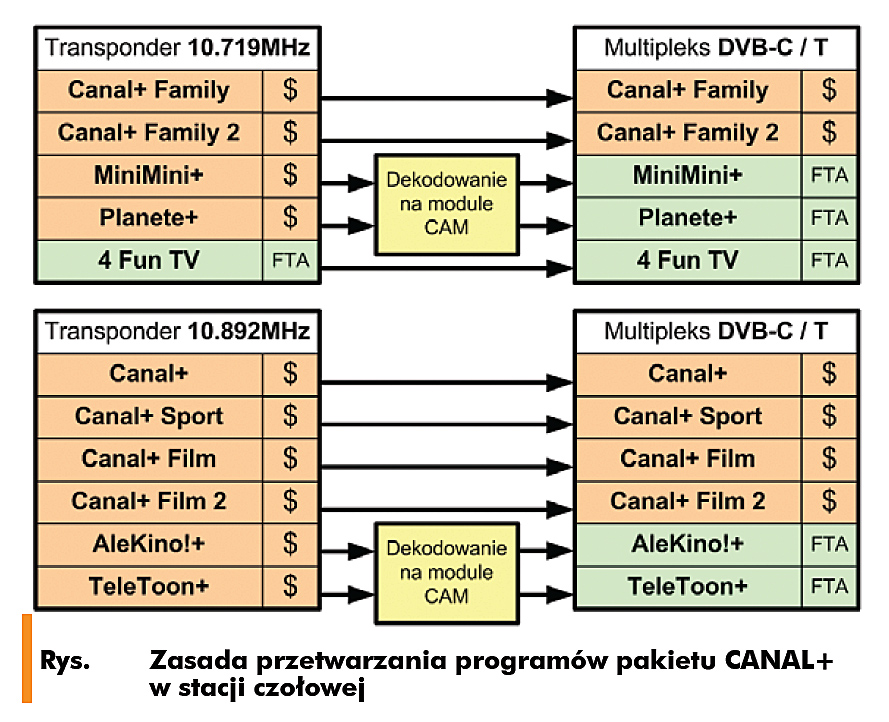
Programmes processed in this way from both satellite transponders are delivered to subscribers. Most cable networks that have started retransmission of the digital CANAL+ programme package use DVB-T technology. This choice is, on the one hand, a significant saving for the cable operator, who did not have to invest in its own DVB-C decoders, and on the other hand it allows subscribers to make full use of the functionality of the LCD televisions they have bought, with built-in DVB-T tuners. Some operators chose DVB-C technology, which is supported by newer models of LCD televisions.
In order to receive the CANAL+ package, a subscriber can use various technical solutions depending on the television the subscriber has. Owners of new TV receivers can install a GAM module directly in the television. This solution is elegant in its simplicity and the most convenient, because the subscriber uses only the television remote control to switch all TV programmes. Owners of analogue televisions use an external DVB-T or DVB-C receiver with a GAM module installed. Example equipment configurations are shown in the figure:
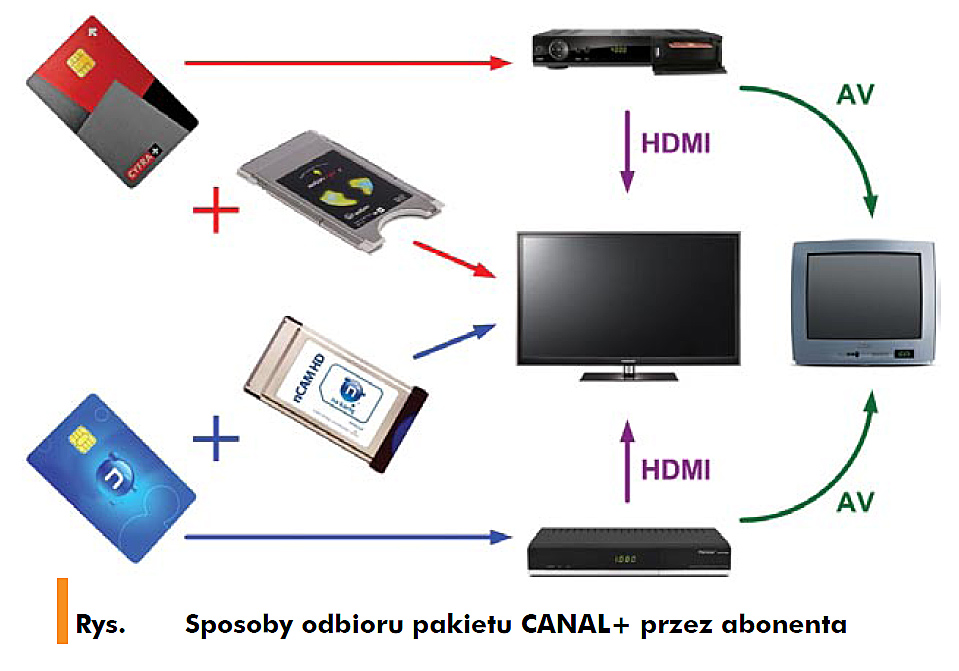
Initially only the SECA/Mediaguard coding system was used, and cable operators provided their subscribers with Cyfra+ cards with appropriately modified entitlements. In recent months, as a result of the merger of the digital platforms n and Cyfra+ and their transformation into the nc+ platform, a new technical possibility has appeared: use of the CONAX system and of cheaper GAM modules. Leaving aside, however, the technical details that distinguish the two conditional-access systems, the way programmes are received is very similar — either using a GAM module installed in the television, or by means of an external digital decoder.
Subscribers who have a new LCD television can also use an external digital decoder. Using an external receiver together with a digital television has the additional advantage of being able to record one programme while watching another. The subscriber can programme the recording of one item on the digital receiver, while watching another programme on the television screen.
An essential feature of implementing the CANAL+ package in the solution presented is the requirement that the subscriber have a suitable GAM module or a digital receiver with a decoding card.
Most often the subscriber has to buy the appropriate device, which on the one hand requires a certain outlay and may in theory limit the number of subscribers, but on the other hand such a subscriber will not be inclined to give up too quickly the CANAL+ programme package just purchased, which in effect builds a long-term relationship between the subscriber and the cable operator. Introducing GAM modules in the CONAX system into the offer has substantially reduced the cost of the technical equipment the subscriber needs, thanks to which winning new subscribers for the purchase of the CANAL+ package has become easier.
Implementing the CANAL+ package in the SD version need not require the operator to incur any additional financial outlay, provided the existing headend equipment can be used. It may at most be necessary to buy one working panel for the COMPACT headend, which will process the programmes in the way described earlier. The cable operator may, however, decide to implement the CANAL+ package in HD quality only, because the licence fees for programmes in the SD and HD versions are the same.
Starting retransmission of the CANAL+ HD programme package will require a higher bit rate in the DVB-C or DVB-T digital channels. These programmes can be processed in such a way that two HD programmes are placed in each digital multiplex, so 3 digital multiplexes with these programmes will need to be created. In that case, 1 or at most 2 working panels for the COMPACT headend will be needed. The information presented above gives a general outline of the proposed technical solution.
We invite everyone interested to make direct contact.